
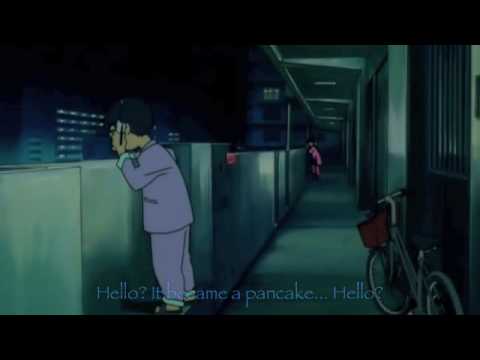
I watched Mind Game director Masaaki Yuasa's pilot episode for the series Vampire Kids, or "Nanchatte Vampiyan." His pilot film is much darker than the series itself eventually turned out, both literally and in terms of mood. I love these backgrounds from it. They have a great sense of atmosphere. It would be fun to work on something in this style, with limited pastel colours and distorted perspective.


Yuasa injected some of his usual idiosyncratic style into the film, although it was so early in his career that not all of his recognizable directorial traits were fully in place yet, and most of his input was abandoned when it became a full series. Some of the more extreme character animation, camera movement and non-sequitur gags give his presence away though.
I've also been watching some of Mamoru Hosoda's work. I really like the way he dispenses with shading on the characters. Most modern anime emphasizes heavily shaded, detailed drawings with very little movement, but he does the opposite. It creates a striking, somewhat flat look, contrasted by his extreme (for animation, at least) use of depth in his compositions. And of course it allows the animators to focus more on the action.


Like just about everybody else, I was introduced to Hosoda's work in the 90s, watching Digimon. The single episode of the series that he directed, somewhere around episode 20 I think, had a completely different feel than the rest of the show-- much more low-key and contemplative. And of course, being set in the real world for once, it was much more based in reality.
Watching that episode when it came out (and even more so the two theatrical Digimon films he directed), I was fascinated by seeing these familiar fantasy characters engaged in relatable real-life situations rather than fighting some giant monster-of-the-week, which was starting to bore me even at that age. I particularly liked Hosoda's attention to mundane details, like kids running around their home in their socks rather than shoes. It sounds obvious, but most cartoons don't pay attention to that kind of stuff and I found this very refreshing as a kid.

More recently, I got to see Hosoda's films The Girl Who Leapt Through Time and Summer Wars. Both of them retained what I liked about his earlier work.

I think my favourite work of his is still those two theatrical Digimon films though, maybe just for nostalgic reasons. They were some of the first anime I saw with decent animation, after being used to cheap stuff like Sailor Moon, Pokemon and Dragon Ball (although that one did at least have fun designs early on, before it started to take itself seriously).
Obviously I also like Hayao Miyazaki (because who doesn't?), but I think he's a little over-rated. I could name lots of other anime directors I like just as much as him. I think the main reason for his fame is simply that he's done so many family-friendly films and created an instantly identifiable Studio Ghibli brand. Generally, anime directors only get to do a handful of original films if they're lucky, most of the time being stuck working on existing franchises. Miyazaki did spend a lot of his early career on Lupin III, but because he was there right at the beginning, he was able to put a lot of his own ideas into it. Even today, the Lupin III anime is heavily based on what Miyazaki did with it early on.
Mamoru Oshii is one of those directors who was stuck slaving away on a series for a long time, and it happens to be another one that I like -- Urusei Yatsura. Based on Rumiko Takahashi's first manga series, the anime version was helped immensely by Oshii's presence; he often gave the show a surreal dream-like feel, and brought a sense of depth to the repetitive throwaway plotlines and gags of Takahashi's original comic.


If the show's humor feels a little bit cliched, it's because this is the series that invited most of those anime cliches. It's hard to imagine a time when 'face faults' were unexpected and fresh, but that is literally how influential this series was. Just about every aspect of it was copied in some way. For instance, the female lead Lum's shtick of giving people electric shocks when she's mad was ripped off by the Pokemon anime.

The series never had a chance to become really popular in North America-- it was already pretty old by the time anime started to become popular here, so a lot of people ignored it. Furthermore, a lot of the verbal humour doesn't translate well, because it's full of Japanese wordplay. Probably because of this, there's never been a successful English dub of the series. It would be almost impossible to reproduce the energy of the original vocal performances anyway. Some of the screaming on this show is hilarious-- sometimes louder really is funnier.

...Anyway, Mamoru Oshii's contributions to the show were summed up perfectly by his final work on it, Urusei Yatsura Movie 2: Beautiful Dreamer. He provided the original story for the film, and was thus finally able to delve completely into what he found compelling in the series. The result was an unusually quiet, atmospheric film in which the characters find themselves caught repeating the same day... nine years before Groundhog Day!


As a longtime fan of the series, it was interesting to see the characters thrown into a more somber, lyrical story. Later on, Oshii became better-known as the director of Ghost in the Shell, which is a pretty amazing movie, but I prefer his lighter, earlier work.


5 comments:
First and fifth images from the bottom: WHAT....THE......FFFFFFFFUUUUUUUUUUCCCCCCCKKKKK?????!!!!! Amazing. I must see these drawings in action as soon as possible. How many of these have you got on DVD?
I've got most of the stuff I mentioned in this post, including a lot of Urusei Yatsura, although sadly I don't have the episodes that those two images come from on DVD.
Most episodes have at least a handful of crazy moments though, even with the sometimes limited pose-to-pose animation.
https://newyorkmnetwork.blogspot.com/
Download Wallpapers Anime
Post a Comment